Showing posts with label Monster High. Show all posts

Sunday, February 2, 2025

Where have all the mermen gone…?


Let's be fair, when talking about merpeople, most (land) people think mermaids, not mermen. We can trace the roots of that all the way to antiquity, with all those sailors, who were very often exclusively men (remember, in many places even having a woman on board a ship was thought to be bad luck) encountering or believing they have encountered all sorts of beautiful water-maidens. Who might have only intended to drown them as a bit of fun, but were beautiful without exception. Most such myths and legends don't specify if male versions of those creatures even exist, or maybe they are just water spirits taking the shape of lovely women to seduce sailors; and even when both sexes are mentioned to exist, the only man who is important is usually a powerful sea king, more akin to a water god then just a conventional male denizen of the deep. Fast forward a few millennia, and Hans Christian Andersen seduces the world with his beautiful yet tragic Little Mermaid. Again, it is all about the female heroine, and a little about her sisters and her grandmother, and, alright, her father as well. Fast forward again to Disney, who gives the little mermaid a name, red hair and a rebellious nature she never had in Andersen's fairytale (and unforgivably omits the grandma!), as well as a happier ending, and, well, you know the rest. At least since then, little girls love mermaids and there are lots of mermaid books, cartoons and dolls around.

Still, Disney's Little Mermaid did show, at least in glimpses, a normally populated underwater society with merpeople of both sexes in it: Ariel and her sisters may have been the stars, but it doesn't seem like female mermaids otherwise vastly outnumber the males. And various less widely known fictional universes, including a number of tabletop roleplaying games, have merpeople/merfolk as a normal race inhabiting their worlds. (Some of those merfolk may be a little fishier in appearance, but that's beside the point.) And, come to think of it, I will have to write another post dealing with the narrative side of all this later, as it is very interesting – but today, our subject are dolls.

So, a little girl, an adult enthusiast or anyone in between may desire to have a number of dolls to represent a beautiful underwater society, be it that of Disney's Atlantica or some other. And there, of course, we run into the same problem as when we want male dolls of more or less anything: there may be mermaid dolls aplenty, but mermen are few and far between. Let's have a look at what we have on the market! I'll focus on the 1/6 scale (the equivalent of Barbies and similar dolls, around 11" / 30 cm in size) as the most frequently collected and having the most mermaids to begin with, but the situation is hardly better in others (and most probably worse).

First of all, of course, Disney gave us King Triton. Minor differences in models of the cartoon doll aside, you know him – the old wise king with the grey hair and beard. Plastic hair and beard, alas, but still, he's a good start. I have the old one with the plush tail, and he's sadly significantly shorter than the modern mermaids, but he's still pretty good nevertheless. Who says a king can't be short. 


There is also a 16" version in a very expensive collector's set with Ariel that may be a bit too big to combine with 11" dolls, but that is theoretically useable if you want to aim for a god-king idea. He could nicely be a Poseidon type, towering over other merpeople. Price aside, alas. 

The new live-action Little Mermaid film, as inferior as it may be in writing to the original cartoon, at least provided us with a King Triton doll sufficiently different from the old one – darker-skinned, somewhat younger-looking (middle-aged rather than old) and armoured. Personally, I dislike the combination of rooted hairs and plastic beards: on some dolls it can look acceptable (I'm fine with the Dumbledore and Hagrid from the Harry Potter line), but here it just leaves an incongruent impression, perhaps because of the colour differences as well. So, we have two older mermen. While you are unlikely to need two kings (unless you're making two kingdoms), remove the crown off one of them and they could be an old king and his younger, armoured general, or, vice versa, a middle-aged king and an old wise advisor or wizard. Or one can just be someone's father or grandfather, of course.
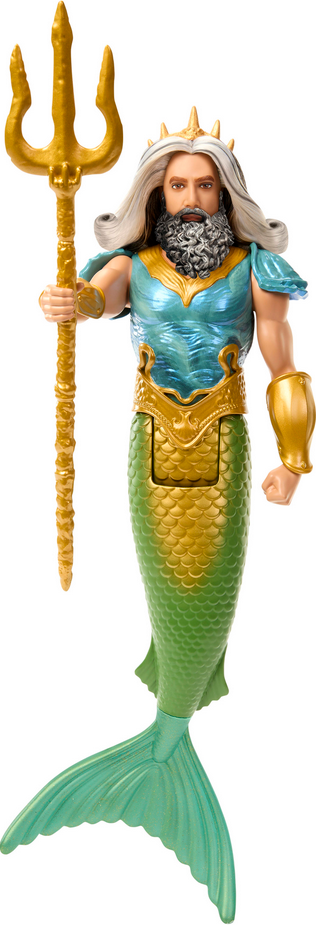
If you want a young king or prince, there are also two very impressive, albeit expensive, dolls: Mattel's King Ocean Ken, and the Mizi Adonis Poseidon. They may not both be to everyone's taste – Ken's looks are more masculine, despite the fact that his colour is pink, while Poseidon has a somewhat androgynous face combined with a more neutral white and green colour scheme. (Mizi dolls are also somewhat taller than Barbies, 13-14”, so count on him being unusually tall, but not quite a giant.) But, if you like them and can afford them, either would make a fine addition to your ocean court.


"But enough with the court!" you may say. "I'm covered there. I want a bunch of regular, civilian mermen to be the brothers and husbands of my regular mermaids!" I hear your plight, but, alas, doll companies do not. For the regular-looking young merman, we have a grand selection of five dolls, and to add insult to injury, four of those all look almost the same.

First and simplest, there is the Dreamtopia merman Ken. Short blond hair, blue tail, a seashell necklace and bracers. I didn't initially like him, but we got him as, well, the market is scarce, and I do have to admit that he looks better in real life than in pictures.

A few years before that, though, we had a Ken merman from Barbie the Pearl Princess. He only comes in a double set with Barbie, and he has a plastic removable tail and moulded on armour.

Then, along the transformable lines, there is the Dreamtopia prince Ken who can turn into a merman using his cloak which becomes a tail. I didn't put him among the royalty as he looks fairly underwhelming to me compared to the others there... and he looks almost the same as the regular Dreamtopia merman, all with the bracers and a pink shell necklace. Still, if you want a removable tail, i.e. if you want a merman who can become a man by magic, these two are the only options on the market. Though, to be honest, he looks a little funny, as the feet are visible beneath the fins. You'd be better off custom-sewing a tail and applying it to a Ken with ankle joints, who could straighten out his feet while keeping them inside the tail.

Outside of Mattel, we have a lovely Simba mermaid family set, featuring a pregnant Steffi mermaid with a removable baby, and her husband who... is so obviously a cheaper copy of the Dreamtopia merman Ken. Sigh... I could theoretically see myself buying the set because it has a pregnant mermaid and a baby one (though I dislike the fact that she has a moulded-on bra top – why would a newborn baby need one?), and, yes, because male mermen are few, but he is really not particularly impressive on his own.

The only different one among them is the only Color Reveal merman. Yes, in all the Color Reveal Mermaid lines (not even sure how many there were, but there were multiple waves), there was a total of one Ken. I really like his silvery colours and long hair (though I would have preferred it without the undercut), and I would generally like to obtain him, but I do have to warn you of one flaw of all Colour Reveal mermaids: for whatever reason, they don't bend at the waist. They can move their arms and heads, but no sitting, realistic swimming poses, zip. As if it’s a conspiracy to make all Color Reveal dolls as un-poseable as possible.

To be fair, there is also one fairly irregular-looking merman, and that is Monster High’s Finnegan Wake. (Yes, of course his name is a pun on the famous novel. Practically all the MH names are puns of some sort.) He won’t quite fit in the standard fairytale merfolk society, as his skin is blue, he has a tall mohawk and is tattooed as well – but maybe a young punk mer-teen is just what you want? (I emphasize teen, as Monster High dolls are a little smaller than Barbies. However, he makes up a little with his tall mohawk.) He can not only sit down, but his tail bends at the middle, roughly where a human’s knees would be. And while in Monster High he does have a disability (a problem with his tail), overall, lots could be done with the idea of putting merfolk in wheelchairs (in a modern setting) for when they wish to visit land, and tails-to-legs magic either isn’t easily available, or they’re sceptical about it.

Finally, to lighten up the grim situation, we do have two merman boys in the Chelsea line. One was a Color Reveal doll, and one bought in a regular non-random package... and they're both dominantly green (with a bit of blue). Because, I guess, it's not enough that they're few, let's top it by them looking alike. OK, they are visibly different enough that you wouldn't confuse them outright, but why couldn't one have been, say, purple or red?

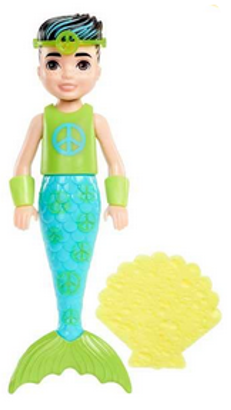
So, that's it. Two (and a half) old kings, two young (and expensive) kings or princes, one long-haired sitting-impaired young merman, one punk-styled blue one, four more short-haired blond ones who might as well be brothers, if not outright quadruplets, and two fairly similar green boys. A total of a dozen dolls might not be terrible, but it's still pretty bad when you think of the fact that three of those are above most people's doll budgets, and of the remaining ten, three or four adults and the only two boys are very, very similar. Compared to the vast numbers of female mermaid dolls out there, it's really pretty sad. 

 I don’t think I’ve missed anyone, have I? I originally thought Mattel might have had an older Ken with a removable tail (maybe in the 90s), but I can’t find any trace of one. There are several modern mermaid doll lines (Mermaze, Mermaid High…), but as far as I know, they only have girls. I’ve seen people on the internet make quite impressive customs – the Dreamtopia merman with a head swap being the easiest way to go – so that’s definitely an option for an individual collector, but, personally, I’d really prefer to see more merman dolls on the market, available to everyone. What do you think?


Edit: another potential merboy!

Courtesy of ThunderStruck on the Alluring Dollz Discord server, we have another honourable mention. Namely, the ChuChu Mermaids dolls, while envisioned as little mermaid girls, have removable bow bras – and little girls’ flat chests might as well belong to boys. Here is an official image of the line with their bras removed:

While my reflex personally would still be to view them as girls, I admit that in the manga/anime aesthetic that they’re made in, a gentle-featured young boy is perfectly plausible, particularly if dolls with shorter hair are used, e.g. the yellow or blue one. So, if you like this style, I guess there are some more options for little mermen!


Sunday, October 13, 2024

A human named Humie and a princess named Beauty


Many forms of popular media, particularly children’s, contain characters who have names related more or less directly to their species. Naturally, this goes only if the characters are non-human: so it will be an animal or fictional species that is recognizable to the audience by some easily noticeable trait or traits. This may go for all the characters in the story, but it is also quite common to have such naming only for members of “minority” species, causing them to be at least partially defined by what, and not who they are. (This is markedly different from characters having meaningful names that relate to their own personality or other individual, not racial, powers and traits.) Presumably, this serves to make the characters stand out, be memorable, or simply be funny. The site TV Tropes is full of examples - check out A Dog Named “Dog” and many similar tropes linked in there if you wish.

But let us look at a few examples directly to illustrate the point. A childhood favourite, Care Bears all have different powers and related names, most of them not particularly associated with bears as animals: Tenderheart Bear, Cheer Bear, Share Bear, Grumpy Bear, etc. However, when we look at the Care Bear Cousins from the Forest of Feelings, there is only one of each animal species, and they are all named after something typical of the species: thus we have Swift Heart Rabbit, Brave Heart Lion, Lotsa Heart Elephant and so on. And Noble Heart Horse, whom you’d never guess is a horse, but that’s another matter.

Speaking of horses, My Little Pony has a variety of meaningful names for the pony characters - ranging from dramatic, romantic ones such as Twilight (Sparkle), Majesty or Sunset Shimmer, to those based on various forms of tasty (usually sweet) food, such as Cotton Candy, Minty or simply Yum Yum. While pony naming customs in the franchise could merit an article of their own, the vast majority of them aren’t particularly horsey-themed. But not so with other species in the pony world(s). Let’s take zebras as an example. (Though we could also mention Catrina/Katrina the cat woman, Rep the shape-shifting reptile, etc.) The first generation of My Little Pony had only two zebra characters: a greedy villain named Zeb (in the show, but with no toy, as G1 didn’t produce any toys of antagonists), and a cute little friend of the ponies named Zig Zag (in the comics, with a toy made). Both had only episodic roles: no distinctive zebra culture was implied, and their names were only meant to start with Z and remind us, in Zeb’s case, of the species’ name, or, in Zig Zag’s, of zebra stripes. (Though her stripes mostly don’t go in zig-zag!)

Zebras returned in G4, first in the face of Zecora. This time, they obviously had a culture different from that of the ponies and modelled on African cultures - appropriately enough, since real-world zebras live in Africa - and it was precisely Zecora’s exotic looks, strange customs and unusual manner of speech that served as a red herring in her first episode, posing the question of whether she’s a villain, and then breaking that trope and giving the ponies and viewers a lesson in tolerance and multiculturalism. And yet her name not only resembles the word ‘zebra’, but also means ‘zebra’ in the Oromo language. At least she wasn’t Karl Freund. It does bear mentioning that other zebras who appear later on (mostly in the comics) have much more varying names - but none are nearly as prominent as Zecora.

If the difference between species is greater, the species-naming may be even more obvious. Many cute children’s picture books have characters named solely by their species - Mrs Rabbit, Mr Wolf, Miss Mouse etc. - but some more serious works have them, as well. Take Narnia: not even counting that Aslan’ name means ‘lion’ in Turkish (a special case, since he is not just a lion, he is the Lion - more on archetypes soon), let’s look at the first creatures the Pevensie children meet in Narnia. Lucy first meets the faun, Mr Tumnus, who has a proper name, and then we have… Mr and Mrs Beaver. Now, we could, maybe, presume that they do have first names, but that it is a Narnian custom to use animal species as a sort of last name. Lots of children’s media do that - you need look no further than Mickey Mouse or Peppa Pig. But then again, Lewis never states this explicitly in the Chronicles of Narnia. We never learn not just the Beavers’ first names, but even if they have any at all. Lewis seems to have let go of this approach in later books, as further animal characters do have names - but in the beginning, Mr and Mrs Beaver obviously sounded fine to him.

In some franchises, practically all characters are walking species stereotypes. Think of Monster High and Ever After High. In the first, everyone is named after the type of monster that they are, or some notable characteristic of that species, sometimes with puns: thus we have Draculaura, Clawdeen Wolf, Abbey Bominable, Ghoulia Yelps, Heath Burns, etc. In the latter, the names are based on the fairytales that the characters, or rather, their parents, come from: it’s enough to gaze at the names of Apple White, Briar Beauty, Alistair Wonderland or Hunter Huntsman to understand which famous fairytale characters are their parents. It’s similar with Disney’s Descendants, although they went with regular names that sound like the parent’s names or even nicknames: Aurora’s daughter Audrey or Jafar’s son Jay may still sound plausible, but ‘the Evil Queen named her daughter Evie’ really strains credulity.

And that is, of course, the whole problem we as the audience may have with such names: they don’t sound plausible. Pet names, as described in the aforementioned TV trope, are different: we can imagine an owner naming their cat Kittie all too easily. We might have met such pets, or we might even be such owners ourselves. But would you, human reader, name your child Humie or Humana? Maybe, if you want a fancy name, you’d go for Homosapienta? Of course not. Even going with a name based on one’s nationality would likely sound pretentious or in bad taste. So why would we expect zebra parents to name their son Zeb, or zombie parents to name their daughter Ghoulia? And it gets even worse if we don’t think about it as individual parents with weird naming choices (those do happen!), but entire races or cultures naming their children only things that have a strong resemblance to what they are as a race, which would have to be the case if, say, all zebras have zebra-sounding names. It would sound like a caricature.

So, does that mean you should never use such a naming strategy? That it’s a mistake that just makes your characters sound unrealistic, to be avoided at all costs? Well, not quite.

First, a caricature may be precisely what you want. Monster High’s show writers and doll designers didn’t really think all monsters would want names that are puns on what they are: they just don’t take their universe too seriously, very much on purpose. If you’re writing something that’s supposed to be comical, you may play with stereotypes and funny and punny names to your heart’s content. If the whole story is fairly tongue-in-cheek, the names won’t really stand out. But if your story is striding the thin line between humorous and serious (think of Terry Pratchett’s hilarious Discworld books or The Order of the Stick webcomic, which manage to drive some very deep messages and have highly emotional scenes despite essentially being parodies of fantasy works and RPGs), you may want to make sure that silly names, whatever their format, do not reduce the impact of your dramatic scenes.

But humour isn’t the only reason that may justify a certain type of stereotypical names. Another valid reason could be if your characters are meant to be archetypes. That is most often the case with classical fairy tales: a protagonist is there to fulfil a certain archetype - say, of a strong and brave hero or of a kind and merciful motherly figure - and often doesn’t have distinct personality traits. They often don’t even have names: they are just “the (brave) young man”, “the king’s (beautiful) daughter” and so on. And even when they do have names, they often just describe who and what they are. Snow White has that name because her skin is white as snow (which Disney seems to have forgotten lately), and nobody else in the original fairy tale is named. Cinderella’s “name” is really a mocking nickname coined by her stepsisters due to her often being smudged by ash and cinders: while some modern retellings have taken the opportunity to claim that her proper name was Ella, that doesn’t exist in the original story (nor is it originally in English). Trope hero names are also common: it would probably be hard to count all the Russian folk tales where the hero is called Ivan, regardless of whether the concrete Ivan is meant to be a lazy village boy or an emperor’s heroic son. It’s not implied to be the same Ivan in all these stories: Ivan is just the name of the Hero, any hero. Fables show this all the more: their animal heroes are just meant to embody certain human characteristics traditionally associated with that animal. Foxes are cunning, so a fox is there just to represent a cunning person: it, thus, suffices for it to be called the Fox, and nothing more.

If your story embodies that sort of archetypal writing and characters, race names are, once again, quite safe. If your cartoon or picture book is just about a hare and a bear, you may as well call them Hare and Bear. That is not to say that those are their names, or that they have no names: those are their roles in the story. They may have names. The names, unbeknownst to the reader or viewer, may be Johnny and Janie, or they may be Bartolomeo and Theodosia, or they may be Runs-through-the-Thickest-Grass and Collects-Honey-All-Year-Round. They may be combinations of animal sounds that we could never translate or transcribe in human letters. But for such a story, with a stereotypical Hare and Bear, their proper names are irrelevant. Even if Hare comes to meet Bear’s family, it will suffice to call them Mother Bear, Father Bear and Brother Bear. Or they may even be Honey, Teddy and Cuddly.

But if Hare comes to Beartown and meets dozens of bear characters there, this approach is no longer the best. The characters may even all have very stereotypical roles, but can you imagine Hare visiting (Main) Bear’s school in order to meet Bear Math Teacher, Bear Music Teacher, Bear’s Best Bear Friend, Bear’s Nerdy Classmate, Bear Class Bully and Little Shy Bear in the Back Bench? While, yes, I am making them awkward on purpose, and it could be played more smoothly, it still stands to reason that the more characters you introduce, and the more individual and less archetypal they are, the greater is the need for personal names. And then you may decide whether you want them to have human names or descriptive names with meanings, and so on. That depends on what you want the bear society in your story to be like. But it may be best to avoid Berny and Bearlinda.

A wizard is never late… or is he?

              (Note: if you don’t care about my personal musings about the blog and want to get to the Gandalf bit right away, scroll three ...